Tafal’aalt
The ForgivenTafal’aalt is Driss’s home and the final village before the open desert, a settlement of domed houses and walled gardens beneath Jbel Issomour massif. David Henniger arrives there with Driss’s body and is kept in the family home; the village becomes the setting for the burial and for Abdellah’s decision about whether to punish or release him. Its cliffs and fossil work connect the landscape to the limited means of survival Abdellah sees around him, while Driss’s room makes the place a repository of memories that his father can never fully resolve.
Setting and approach
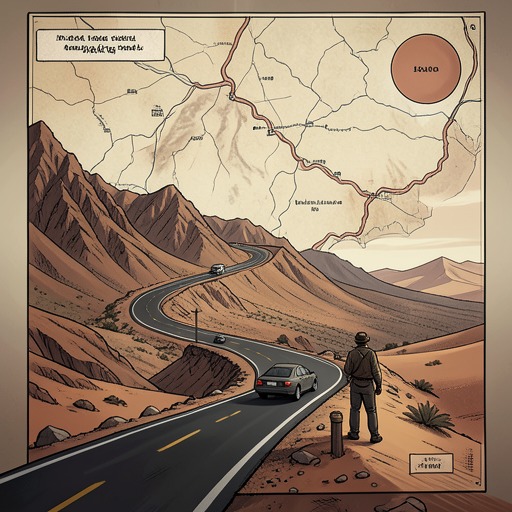
The journey to Tafal’aalt begins at Azna and passes through a chain of villages whose houses share a distinctive form: cement domes and metal doors painted with trilobites. At La’gaaft, Jbel Issomour massif rises above the settlement, its face marked by man-made caves and the ropes and ladders used to reach them. At Tabrikt, people come out to greet the travelers; the repeated encounters establish that the Aït Kebbash are known along this route. Tafal’aalt lies at its end, the last village before the desert opens out.
The village itself consists of about two dozen low, domed dwellings set into the sand. Behind them are vegetable plots enclosed by low stone walls and clusters of date palms; chalk-white paths run between the houses. The shadow of Jbel Issomour massif reaches toward the gardens, making the cliffs an immediate presence in the settlement’s daily setting. The contrast between cultivated plots and open desert locates Tafal’aalt at a threshold: it is both a place of habitation and a community exposed to the surrounding terrain.
Fossils, work, and local life
The trilobites painted on the village doors echo the fossils that Abdellah identifies as one of the few resources remaining to his community. His bleak account joins fossils and children as what the villagers have left, rather than presenting fossil collecting as a source of uncomplicated prosperity. The physical traces of extraction on the cliffs—caves, ladders, and ropes—show how work reaches into the landscape above the houses.
The account also links that work to children. After David’s release, the sound of children tapping at the cliffs recalls to Abdellah an earlier memory of Driss, fifteen years before, secured to a rope while prospecting from a ledge. The recollection gives the present-day labor a family history: Driss, now buried, had once been a boy participating in the same precarious world. The village’s economy is thus conveyed not through statistics but through the repeated presence of fossil work in the landscape and in Abdellah’s memories.
David’s first response to Tafal’aalt is colored by his own alienation and prejudice. On arrival, he regards its conditions with revulsion and interprets the settlement as a place outside familiar standards of order. That reaction is part of his perspective, not a neutral account of the village. The narrative gives concrete details alongside his judgment: homes, gardens, paths, and the cliffs where children work. The tension between what he sees and the dismissive language through which he processes it exposes the distance between the visitor and the people whose home he has entered.
House, funeral, and the presence of the dead
Abdellah brings David to a house with a metal door marked by blue trilobites. Inside, the building is made of cement, its corridor and rooms furnished with coarse carpets; a large chamber contains a gas burner, kettle, glasses, mint, and sugar. These ordinary domestic objects situate David’s enforced stay within a functioning household. At the same time, the voices of mourners outside and the wind striking the window connect the interior to the funeral taking place beyond it.
Driss is buried in a plot of graves in the desert as daylight fades. His mother died years earlier, and his aunts and cousins mourn him while the men stand largely silent. For Abdellah, the burial opens onto memories of taking his young son prospecting across the mountain and finding a Dicranurus together. That fossil, still kept in Driss’s room, links the village’s material world to the private history of father and son. The grave closes Driss’s life in Tafal’aalt, but it does not make him fully knowable to the people left behind.
The room itself preserves that contradiction. David wakes among Driss’s few possessions, including folded clothes, a notebook, a pen in a glass jar, and a small toy. Later, Abdellah enters and recalls the young man who had returned from France changed, secretive about his time in Paris, and increasingly withdrawn from his family. He remembers Driss’s habits and mannerisms, but each detail emphasizes how much remained inaccessible to him. The house is therefore not simply a place where David is held: it is also the intimate space in which Abdellah encounters the limits of what a father knew about his son.
A place of decision and memory
After the burial, Abdellah waits to learn whether David will tell him the truth about Driss’s death. He has delayed deciding what to do until the funeral is over and he has spoken with Ismael. In his reasoning, a deliberate lie would be worse than the accidental death because it would be a chosen act. Tafal’aalt consequently becomes the setting for a moral test as well as a bereavement: Abdellah’s judgment of David depends on the account David gives, not only on the fact that Driss died.
David is ultimately allowed to leave. Abdellah turns away from the jeep and walks toward the dry riverbed as morning breaks; the sounds of a dog, a rooster, and hammers working on the cliffs continue around him. Rather than resolving his grief, the release leaves him alone with it. He returns to the house, makes tea, and remembers Driss at work on the cliffs as a child. In the following night, Abdellah regrets not having killed David, yet recognizes that his deepest wish for vengeance concerned his failure ever to know his son completely. Tafal’aalt holds both sides of that ending: a community still marked by labor and loss, and a family’s memories that persist without supplying a final answer about who Driss was.